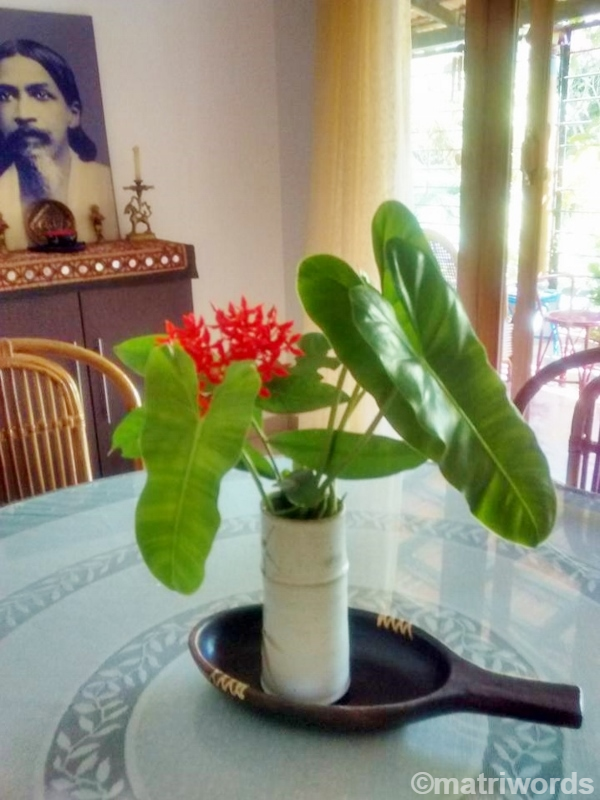
August 15 is Sri Aurobindo's birthday. In honour of this special day, we bring for our readers an article written by Mr. Arup Basu, editor of Sraddha, a quarterly journal published by Sri Aurobindo Centre for Research in Social Sciences, Kolkata. This article briefly lists a few key aspects of Sri Aurobindo's momentous contribution to India's freedom movement. It was first... Continue Reading →
Spiritual Practicality: The Need of the Moment
Author: Beloo Mehra Published in Collaboration, Vol. 41 (1), Spring 2016, pp. 9-10 It seems pretty much every month there is some big international conference going on somewhere, discussing Climate Change, Solar Energy, Global Terrorism and all such important issues of the day. Political leaders, subject experts, public intellectuals, journalists, pretty much everyone... Continue Reading →
The Inner Resources of A Nation (by M. S. Srinivasan)
Some writings are so important that they deserve not only to be read again. But also to be shared again. Like this one by M. S. Srinivasan. "The Spirit is a higher infinite of verities; life is a lower infinite of possibilities which seek to grow and find their own truth and fulfilment in the... Continue Reading →
Two Reflections on Integral Education – 2
Continued from Part 1 First published in Aspiration: An Inner Call, 2008, Vol II, No. 2, pp. 21-26. (Published by Sri Aurobindo Study Centre, Kolkata) II In Integral Education a teacher’s own inner work to discover the spark of divine within is a key factor in facilitating students’ inner un-foldment. Everything else – curriculum, course texts, learning materials, assignments... Continue Reading →
Two Reflections on Integral Education – 1
First published in Aspiration, 2008, Vol II, No. 2, pp. 21-26. (Published by Sri Aurobindo Study Centre, Kolkata) I The other day I was re-reading Sri Aurobindo’s essays on The Renaissance in India and was happy to discover how these essays of the Master may also deepen one’s understanding of the significance of integrating spirituality and life,... Continue Reading →
Chintan: India and Me: Part 6: Connection
Have you read the previous parts: 1, 2, 3a, 3b, 4a, 4b, 5a, 5b? This evening Mridula Di decided to take up the topic the group had just started grappling with in their last discussion. About the outer sheaths and the inner core of an individual and nation. About the connection between the inner and outer.... Continue Reading →
Kolam: Computing and Cosmology within Indian Art (by Shivoham) – Conclusion
CONTINUED FROM PART 2 Cosmology of the Sacred Kolam Why do Tamil women draw Kolams daily at the threshold of their homes? Why not do something else? Such questions and an explanation from a western universal perspective may be found elsewhere. In this article, I present an alternative point of view from my Indian perspective. Menon's article also has... Continue Reading →
Kolam: Computing and Cosmology within Indian Art (by Shivoham) – Part 2
CONTINUED FROM PART 1 History of Kolam Creating paintings on a natural surface has a really ancient history in India, as evidenced by the Bhimbetka frescoes that are at least 15, 000 years old. This news article [2] talks about the use of Rangoli in the Mahabharata, while another forum mentions the design in the Ramayana. Other floor designs, such as the endearing floor... Continue Reading →
Kolam: Computing and Cosmology within Indian Art (by Shivoham) – Part 1
An attempt, a drawing half-done is the world's life; Its lines doubt their concealed significance, Its curves join not their high intended close. Yet some first image of greatness trembles there, And when the ambiguous crowded parts have met The many-toned unity to which they moved, The Artist's joy shall laugh at reason's rules;... Continue Reading →
India, Indology and Deep Colonialism (by Subhodeep Mukhopadhyay -Conclusion)
READ PARTS 1, 2, 3 CONTINUED FROM PART 4 THE WAY FORWARD... Encourage Sanskrit Learning Sanskrit is the language of Indian culture and ethos. The day Sanskrit dies, Indian culture or Sanskriti will also die and Hindus or Indians as a unique people with unique set of values will cease to exist. Anti-Sanskrit forces... Continue Reading →